
Woodridge Previous-Resident Sources
Woodridge address history crosses several eras and access channels. The DuPage Recorder provides the legal chain, but its online search keys begin at different dates. Tax and sale screens supply the newest bridge. Local newspaper holdings add occupants, moves, deaths, and subdivision context. Older work may require an office visit, library desk request, microfilm, archive query, or a narrow records request.
| Source | Years covered | Where held | What it shows |
|---|---|---|---|
| Recorder name/images | 1961 to present online | DuPage Recorder portal | Deed parties, liens, plats, easements |
| Recorder PIN/address | PIN from 1985; address from 1995 | DuPage Recorder portal | Parcel and street document shortcuts |
| Recorder office | Property records from 1839 | Office research in Wheaton | Farm deeds and pre-address land trail |
| Woodridge permits | Year groups from 2017 and older files | Village site; FOIA fallback | Projects, dates, applicants, contractors |
| Local newspapers | News Review 1960-1964; Progress 1969-2005 | Woodridge Public Library | Moves, obituaries, civic and subdivision news |
| Federal census | Public schedules through 1950 | Library genealogy resources | Households, ages, birthplaces, occupations |
| Museum and IRAD | Varies by collection | DuPage Museum; state archives | Maps, directories, real-estate and county files |
An address failure before 1995 does not mean no deed exists. Shift to a PIN, party name, legal description, book and page, plat, or the Recorder's in-office material. The property sale-history record is often the quickest handoff because it supplies a document number, parties, date, price, and deed type.
Walk Woodridge Deeds Backward
A chain of title is the linked sequence of recorded ownership instruments for one parcel. Begin with the current PIN and legal description in the property record, then use the DuPage Recorder search. Keep every document number, date, party role, deed type, and lot or block. When an instrument changes the legal description, reconcile it with the plat before going farther.
- Pull the current owner, PIN, sale-history document, and legal description from the DuPage property record.
- Open the newest purchase deed. Copy the grantor, grantee, recording date, deed type, and parcel description.
- Search the seller as an earlier grantee. Match by parcel, subdivision, spouse, trust, or cross-reference, not name alone.
- Repeat until the online key stops. Before the cutoff, use book and page, plat, township-range-section, microfilm, or office deed books.
- For a Will or Cook edge parcel, switch to that county recorder. The Woodridge postal name does not choose the custodian.
- Grantor
- The party transferring an interest in the recorded instrument.
- Grantee
- The party receiving that recorded interest.
- Chain of title
- The sequence of instruments affecting ownership.
- Legal description
- The formal land description, often by subdivision, lot, block, or survey.
A deed party is not always a previous resident. A trust, lender, corporation, trustee, or correction instrument may name a party that never occupied the house. Record the role precisely and seek a second source for occupancy.
Woodridge Addresses Across Eras
Woodridge grew from rural and farm land into a planned suburb. Winston Hills appears in the 1964 development story, Woodridge Center in a 1972 annexation, Woodridge Drive in 1974, and Wilton and Pillsbury growth in 1977. These events explain why an older deed may describe a farm while a current record uses a subdivision street.
No official street-renumbering year was located. When an old street string disappears, bridge the gap with the PIN, original plat, lot and block, township-range-section description, annexation ordinance, or plan commission packet. Keep 60538 as a historic postal search term where a current 60517 query fails.
Woodridge Public Library's Black Acres history gives a local model: the Nadelhoffer farm moved from an 1873 purchase to a 1972 development sale. It does not identify every later occupant, but it shows why parcel, plat, newspaper, and GIS evidence must be joined.
Permits Date Woodridge Changes
The Woodridge issued-permit pages organize public PDFs by year and month. A permit can date a new home, addition, deck, roof, garage, basement finish, or pool even when title did not change. It may name an applicant or contractor, whose role should not be called a resident without other evidence.
When a posted summary is incomplete, request the existing file from Community Development under Illinois FOIA. Give one address, a date range, and a project type. Ask for inspection if the file is large. Village board and plan commission documents may also identify the subdivision or developer tied to a street.
Public utility billing is not a household directory. No customer list should be assumed public, and any request remains subject to exemptions.
Woodridge Newspapers Add Occupants
Woodridge Public Library's early newspapers include the News Review and Progress. The Progress has a searchable in-library image subset for 1969 through 1978, while its wider print or microfilm holding runs through 2005. Move notices, obituaries, clubs, school news, legal notices, and subdivision reports can place previous residents in a dated setting.
Search an address, surname, subdivision, street without its suffix, and old ZIP. If the online subset ends before the target year, ask library staff for the physical or microfilm run. The DuPage Historical Museum holds maps, real-estate records, directories, clippings, and vertical files, but exact title years should be confirmed before a visit.
The Woodridge city directory collections provide more shelf detail. For address history, use each volume only to test one place and year.
Maps Test Woodridge House History
The Library of Congress Sanborn guide explains fire-insurance map searching, but no Woodridge-specific atlas was confirmed. Nearby Downers Grove has listed years from 1892 through 1947. Since Woodridge incorporated in 1959 and much growth came later, a county atlas, pre-village farm map, or subdivision plat may be more useful.
The captured source below is search guidance, not proof of a Woodridge Sanborn volume.
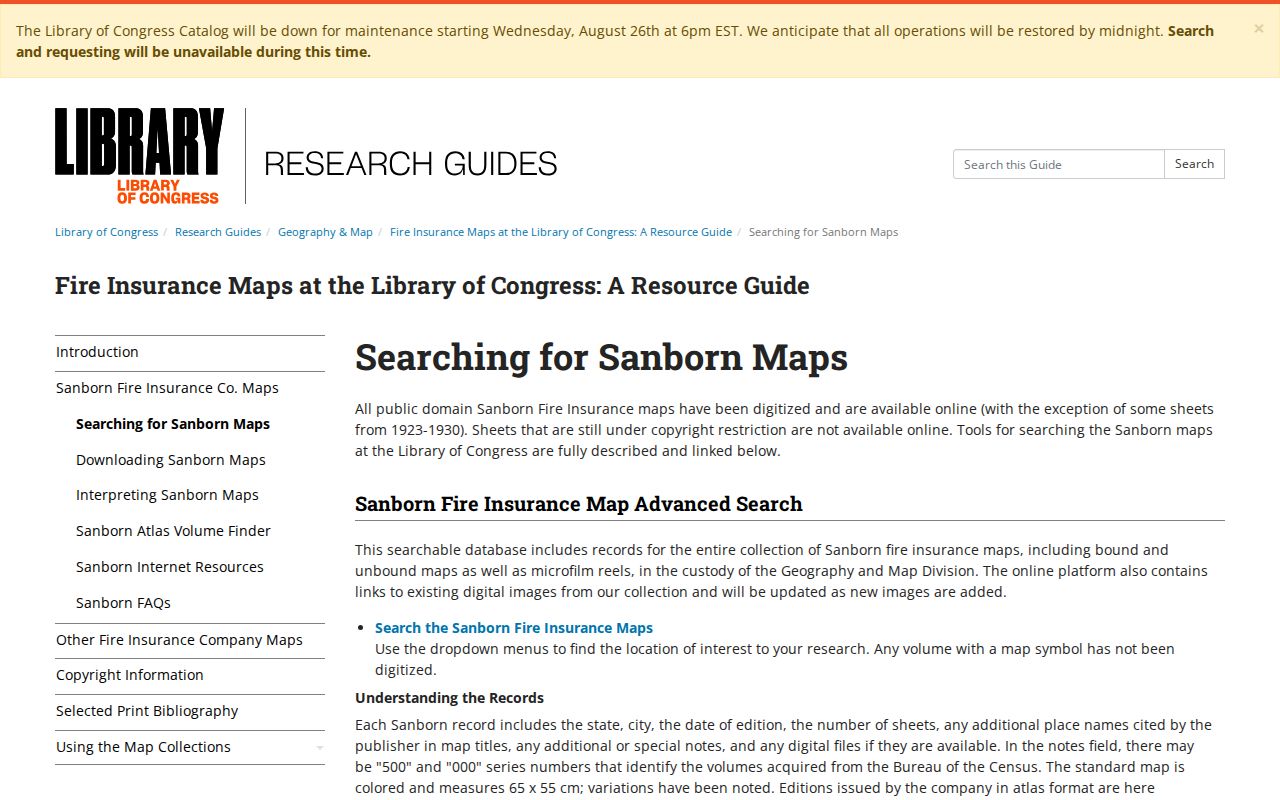
Use place-name and county variants, then confirm any map against the parcel legal description and development date.
Close the Woodridge Resident Trail
Pair newspaper or directory years with public census schedules through 1950. Before incorporation, a Woodridge-area household may appear under a township, rural enumeration district, farm, or nearby town. Census entries can show household composition, ages, birthplaces, and occupations, but they describe one enumeration date and may contain spelling errors.
For a former owner who died, an obituary or probate case may identify heirs and a final address trail. Vital certificates have eligibility rules and are not an open name database. IRAD lists older DuPage birth, death, marriage, naturalization, school, board, and county holdings, while county and state custodians handle certified copies.
Lawful use. Research previous residents for house history, genealogy, or estate work. Never use an address trail to harass or track a living person.
Distinguish recorded owner, deed party, permit applicant, historical occupant, obituary subject, and census household member. If the official trail stops, record the gap instead of filling it with a guess.
Previous residents can also leave a trail through the Woodridge Community Portal. Search a street, subdivision, developer, owner surname, or legal description in board and plan commission packets. An agenda attachment may explain an annexation, plat change, road dedication, drainage feature, or development phase that caused the address to shift. The village portal is an online channel; the Village Clerk and a focused FOIA request are the fallback when an attachment is missing.
The DuPage Historical Museum is the better repository for real-estate records, maps, directories, personal papers, photos, and vertical files. Contact staff with the address, subdivision, known owner, and time span. Ask whether the relevant title or box is available before traveling. Woodridge Public Library is the first stop for local newspapers, photos, oral histories, genealogy databases, and the in-library Progress images. IRAD and the Illinois State Archives extend the search into older county material.
Keep negative searches. Note the exact spelling, year range, repository, and search field that produced no result. An absent address in one directory may reflect a missing volume, a rural route, an unindexed unit, or a neighboring-town label. It does not show that nobody lived there.
One practical timeline uses four columns: date, source, named role, and address form. Enter the assessor owner as recorded owner, the deed parties as grantor and grantee, a permit name as applicant or contractor, and a newspaper name as the role stated in the article. Then place census or obituary evidence beside the land trail. This keeps the ownership and household stories connected without merging them.
When the address predates the subdivision, work from the original plat to the parent parcel. Record lot, block, subdivision name, plat document, easements, common areas, and every later split or combination. A modern tax card can cover several old descriptions, while a condo address can cover many separate PINs. Legal land continuity is the key to finding the right previous residents rather than people tied to a similar street number.
For a suspected move, compare the last local newspaper or directory appearance with the next deed, probate filing, business record, or official unclaimed-property lead. Do not treat a later mailing address as a current home without confirmation. Date each transition and cite the record that supports it. A clean stop date is often more useful than a long chain of uncertain matches.